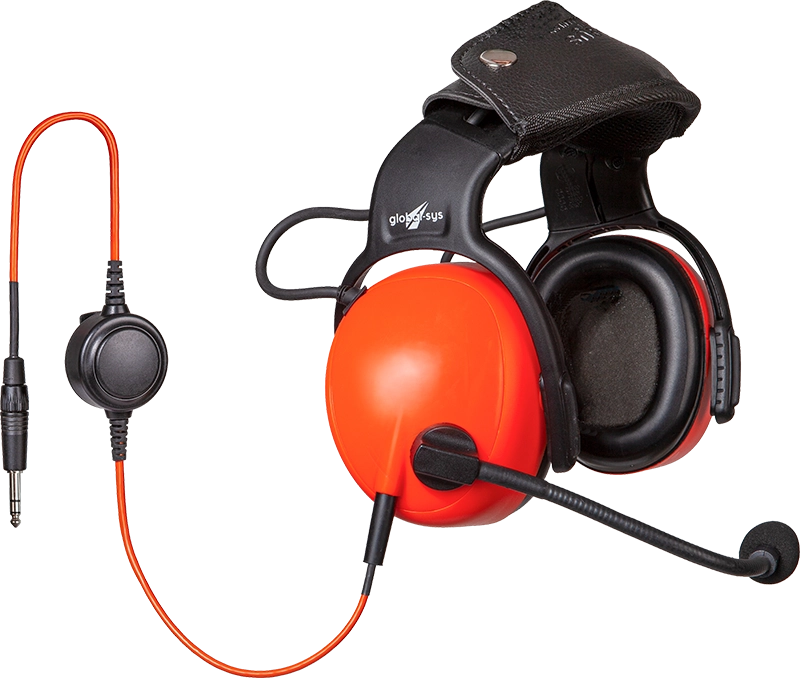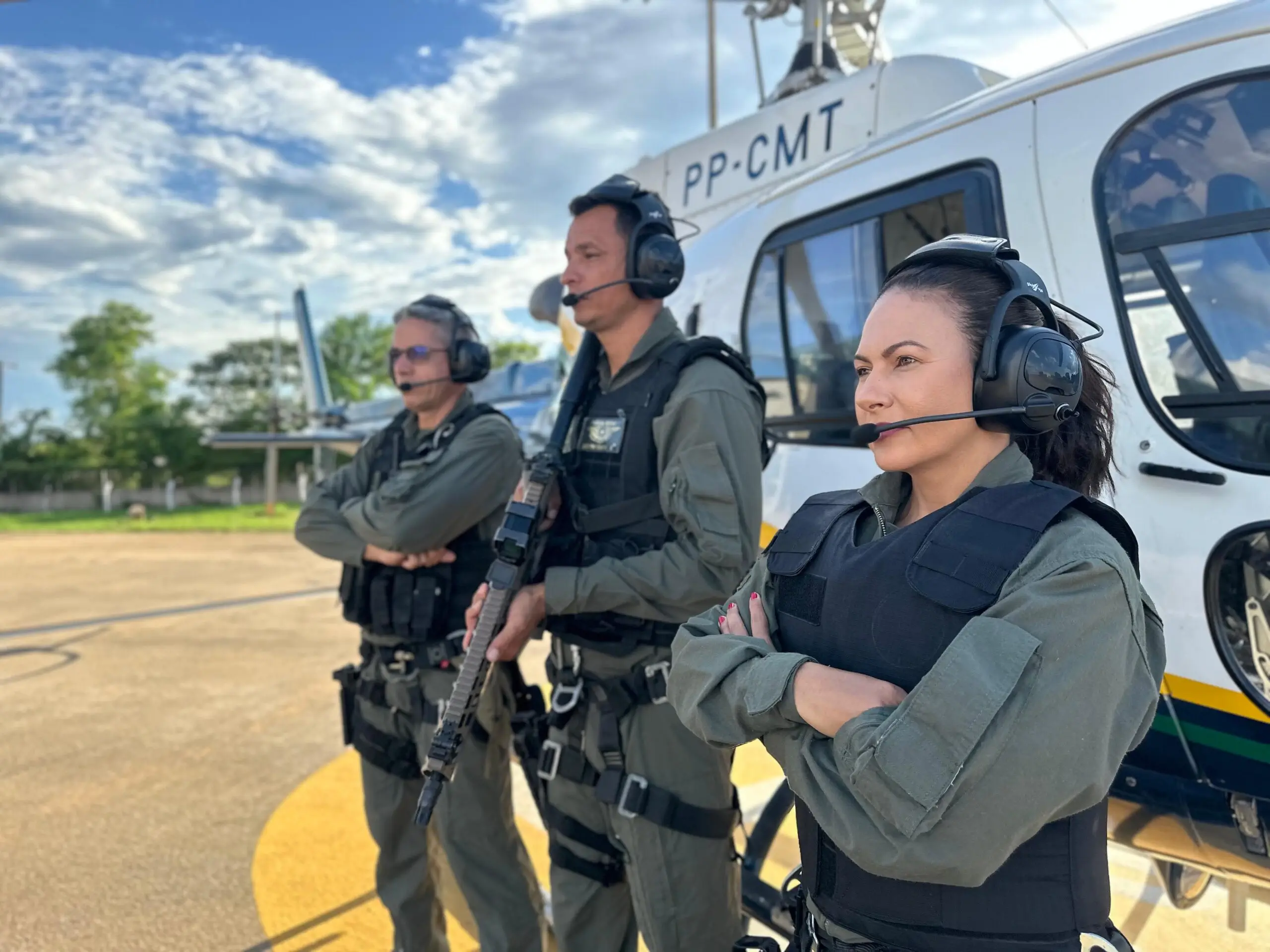



What that means in practice. Most operators start by looking for a comfortable headset for their passengers. What they actually need is a cabin communication system: one that connects every seat at the same time, lets passengers speak freely with each other and with the pilot, and requires no cable at the seat. Until the AUREA H60, the other wireless option most often encountered in the field connected four headsets per base station, with listening capability only: no passenger microphone, no passenger-to-pilot communication.
Who is writing. Global-sys has designed wireless communication systems for noisy environments since 1997, with customers in more than 100 countries. The company is certified ISO 9001 and EN 9100, the aerospace quality management standard. This guide covers the technical criteria for selecting a helicopter passenger headset, the main solutions available in 2026, and the questions operators ask us most often at HAI Heli-Expo and EBACE.
Why Helicopter Cabins Require Dedicated Communication Headsets
Noise levels in helicopter cabins: what the data shows
Helicopter cabins are among the noisiest environments in which people are expected to hold a conversation. Noise levels inside a typical twin-engine helicopter at cruise speed range from 85 to 95 dB(A), with low-frequency rotor harmonics concentrated between 10 and 200 Hz. These frequencies are particularly difficult to attenuate passively.
Every helicopter in operation produces this noise profile. Unlike some modern executive jets, where cabin insulation keeps passive noise levels manageable, no helicopter cabin is quiet enough to make ANR optional. European Directive 2003/10/EC sets daily exposure action values of 80 and 85 dB(A) averaged over 8 hours. At 95 dB(A), the upper action value is reached in less than an hour of unprotected exposure.
Rotor noise has a specific acoustic signature: structured, rhythmic and dominated by low frequencies. Active noise reduction designed for aircraft cabins must address this pattern, which is why purpose-built aviation ANR headsets perform better in helicopters than consumer models engineered for road or office use.
Passenger headset vs. pilot headset: two different products
This distinction comes up every time we demonstrate the AUREA H60 at a trade show. A pilot headset is designed around a single user communicating with air traffic control. A passenger headset works in a fundamentally different context.
Passengers do not connect to ATC. They connect to each other, to the pilot on intercom, and to onboard entertainment. The requirement is multi-directional, simultaneous and hands-free. Asking a VIP passenger to press a PTT button every time they want to speak is not an acceptable user experience.
A wireless system adds a further advantage: the AUREA H60 can be worn on the tarmac and in the lounge before boarding. Hearing protection and communication are active from the moment passengers approach the aircraft, so rotor noise on approach is already attenuated and the pilot can brief the group before they step on board.
Wired cabin systems vs. wireless intercom: the real barriers to adoption
Wired systems have been the default in helicopter cabins for decades, because until recently there was no credible wireless alternative designed for this environment. The Bose A20, a wired ANR headset with microphone, is the market reference for helicopter passenger use. It is robust, well regarded and widely deployed. Plugged into the aircraft intercom, it gives each passenger two-way communication with the pilot and the other passengers.
Its limitation is structural: one headset requires one physical jack. Many helicopter models do not have enough intercom jacks to equip every passenger at the same time, cables run across the cabin, and the headset cannot be used before boarding. The Bose A30 is the latest model in the Bose aviation line; among the operators we meet, the A20 remains the most widely deployed.
When operators consider switching from wired to wireless, two practical questions come up consistently. The first is cost: a wireless system represents approximately three times the unit investment of a wired ANR headset. The second is battery management: a wired headset has no battery to charge or replace. Both are real considerations. Demand for the AUREA H60 has nevertheless been strong from the outset, particularly among VIP transport and Oil & Gas / offshore operators, where the operational benefits of wireless outweigh the additional investment.
On the wireless side, DECT offers the best combination of range, voice quality and low latency currently available for this application. It operates in the 1870 to 1930 MHz band, adjusted according to local regulations, which covers every existing market. This band is separate from Wi-Fi, Bluetooth and avionics RF systems. The AUREA H60 offers a range of up to 300 metres in open field and latency below 12 ms. Once a channel is selected, the system is designed to avoid interference with other DECT communication clusters.
The practical question for operators is installation. A plug-and-play base station such as the Airlink 3085 mobile base can be operational within hours, without structural modification and without any certificate to request from the aircraft manufacturer. Depending on their own procedures, some operators carry out an internal airworthiness validation, which they manage themselves. For a fixed base station, the process varies by airframe, and the Global Sys technical team confirms the requirements for the specific aircraft type and regulatory context.
Key Technical Criteria for Helicopter Passenger Headsets
Before comparing solutions, the following table summarises the six criteria that matter most when specifying a helicopter passenger headset.
| Criterion | What to check | Why it matters for helicopter operations |
|---|---|---|
| ANR performance | Active noise reduction depth (dB), frequency range covered, performance at low frequencies (rotor noise: 10 to 200 Hz) | Helicopter cabins generate 85 to 95 dB(A) of broadband rotor and engine noise. Passive attenuation alone is insufficient for voice intelligibility over long flights. |
| Wireless protocol | DECT vs Bluetooth vs Wi-Fi vs proprietary RF: interference immunity, range, latency | Bluetooth is consumer-grade and prone to interference in avionics-rich environments. DECT operates in a dedicated frequency band, with a range of up to 300 m in open field. |
| Simultaneous connections | Maximum users per base station, conference architecture, chat room capability | A VIP helicopter with 4 to 8 passengers requires full simultaneous connectivity. Systems limited to 2 users are unsuitable for group cabin use. |
| Onboard system integration | Fixed base station or plug-and-play, compatibility with existing avionics, installation time | Retrofit installation should not require structural modification. Plug-and-play base stations reduce downtime to hours rather than days. |
| Battery autonomy | Hours per charge, hot-swap capability, charging infrastructure on the ground | Battery life and field-swap capability must match the mission profile. |
| Manufacturing quality and durability | Aviation-grade materials, vibration resistance, manufacturer quality certification (EN 9100) | Helicopter cabins involve constant vibration and pressure variation. Consumer headsets are not designed for these conditions and fail prematurely. |
Table based on field experience from Global Sys commercial teams and operator feedback at HAI Heli-Expo 2024 and 2025 and EBACE 2025.
A note on ANR and voice intelligibility
The AUREA H60 works on both sides of the conversation. On the listening side, active noise reduction in the ear cups adds to the passive attenuation of the cup design. On the transmission side, an AI-powered noise-reduction microphone separates the voice from the background noise, so the person at the other end of the intercom also receives a clean signal. Audio performance covers 20 Hz to 20 kHz for Bluetooth streaming and 20 Hz to 7,000 Hz for intercom communication.
For executive jets, the picture is different: some modern cabins are insulated well enough that ANR brings comfort rather than operational necessity. For helicopter operations, ANR is always relevant.
Wireless Cabin Intercom Systems: What the Market Offers in 2026
The market for dedicated helicopter passenger headsets remains a specialist category. The table below maps the main solutions available in 2026. It is not a ranking: each system addresses a different set of operational requirements.
| Solution | Type | ANR | Connection | Simultaneous users | Voice capability | Primary use |
|---|---|---|---|---|---|---|
| GLOBAL SYS AUREA H60 | Wireless intercom headset | Yes, plus AI noise-reduction microphone | DECT, up to 300 m | Up to 16 per base station; up to 3 isolated chat rooms | Full-duplex intercom: passenger to passenger and passenger to pilot, no cable | VIP helicopter, executive aircraft, Oil & Gas / offshore |
| Bose A20 / A30 | Wired ANR headset with microphone | Yes | Wired, one intercom jack per headset | 1 per available jack | Two-way intercom through the aircraft jack | Market reference for passenger use; A20 most widely deployed |
| Oxytronic iCan WiFi | Wireless passenger headset | Yes | Wi-Fi, fixed base required | 4 per base (up to 12 with 3 bases) | Listening only: no passenger microphone | VIP passengers who only need to listen |
| David Clark DC ONE-X | ANR pilot headset | Yes | Wired, Bluetooth optional | 1 (pilot) | Pilot communication, including ATC | Pilot use, not designed for the passenger cabin |
| Standard wired cabin kit | Passive wired headset | No | Wired, one jack per headset | 1 per available jack | Two-way intercom through the aircraft jack | Economy solution, limited by the number of jacks on board |
Sources: manufacturer technical documentation, operator feedback, trade show demonstrations 2024 to 2026.
For VIP helicopter operators: H125, AW109, EC135 class
In this segment, the requirement is clear: a wireless system that connects every passenger seat at the same time, requires no passenger action, and installs without structural modification. The AUREA H60 base station connects up to 16 simultaneous users. Batteries are field-swappable, so cabin crew can replace them between legs without tools.
With the new-generation base station, the AUREA H60 supports up to three independent chat rooms. A chat room is an isolated communication group: its participants hear only the members of their own group. The team leader can be connected to all three chat rooms, for example a business group with colleagues, a channel with the pilot and a VHF radio channel, while each group remains isolated from the others. Every other member can be connected to one, two or three chat rooms, as programmed from the base station. This turns the cabin into a place where a meeting can actually be held.
Memory foam cushions and a low-pressure headband are not incidental details. A passenger wearing a headset for 90 minutes notices the difference. The AUREA H60 was developed with comfort on long flights as a core design constraint.
For Oil & Gas and offshore operators
Oil & Gas and offshore operations are one of the strongest sources of demand for the AUREA H60. The operational profile (regular rotary transfers to offshore platforms, mixed passenger groups, high noise and strict communication protocols) maps directly onto the system’s capabilities. The wireless architecture removes the jack constraint that limits wired systems on certain helicopter models, and DECT performs reliably in the dense RF environments typical of offshore facilities.
For light executive aircraft: Phenom 100, TBM, PC-12 class
Light executive aircraft present a different challenge: smaller cabins, fewer passengers (typically two to four) and often no dedicated cabin crew. The voice-activated (VOX) microphone on the AUREA H60 addresses this directly: passengers speak naturally, with no button to press and no instructions to follow.
In jets with very quiet cabins, ANR remains useful for Bluetooth entertainment streaming, but noise suppression during flight is less critical than in helicopters. The intercom and wireless benefits apply equally.
Installation: fixed base station vs. plug-and-play
The Airlink 3085 mobile base can be operational within hours of arrival on site, with no structural modification and no certificate to request from the aircraft manufacturer. For operators managing a fleet across several bases, or charter companies that retrofit aircraft between contracts, this flexibility changes the commercial equation.
Fixed base station installations involve avionics engineering input. Requirements vary by airframe and regulatory context; the Global Sys technical team advises on the appropriate path for each aircraft type.
The rack charger with power supply completes the ground infrastructure: several headsets charge at the same time between flights.
Active Noise Reduction in Helicopter Cabins: How ANR Works and Why It Matters
Passive attenuation vs. active noise cancellation: the physics
Passive attenuation works through physical isolation: the ear cup material blocks sound waves before they reach the ear. It is effective at mid and high frequencies but offers limited protection at low frequencies, where wavelengths are long relative to the cup dimensions.
Active noise cancellation works differently. A microphone inside the ear cup captures the residual noise that gets past the passive seal. The electronics generate an inverted waveform and play it through the speaker, and the two signals cancel each other out at the eardrum. This approach is most effective where passive attenuation is weakest: the low frequencies produced by helicopter rotors and turbine engines.
ANR and voice intelligibility: the intercom dimension
Hearing well is only half of the problem; being heard is the other half. The AI-powered noise-reduction microphone of the AUREA H60 analyses the signal and separates the voice from the background noise before transmission. In a multi-seat conversation across a VIP helicopter cabin, this is the difference between a productive meeting and an exhausting one.
The AUREA H60: the first wireless ANR intercom headset for aviation cabins
Global Sys has been developing wireless intercom systems for demanding environments since 1997. To our knowledge, the AUREA H60 is the first wireless intercom headset combining ANR and DECT currently available on the market. When we brought it to Heli-Expo for the first time, the question from operators was not “why would we need this?” but “why has no one built this before?”
The AUREA H60 is designed and manufactured under Global Sys’s ISO 9001 and EN 9100 certified quality system, with materials selected for the vibration and environmental conditions of rotary operations. Full specifications are available on the AUREA H60 product page.
Frequently Asked Questions: Helicopter Passenger Headsets
How does a wired ANR headset such as the Bose A20 compare with a wireless intercom system?
The Bose A20 is the most widely deployed wired ANR headset for helicopter passenger use; the A30 is the latest model in the Bose line. Plugged into the aircraft intercom, both provide strong noise reduction and two-way communication with the pilot and the other passengers. Their constraint is the connection: one jack per headset, and many helicopter models do not have enough jacks for every passenger. A wireless system such as the AUREA H60 removes that constraint, can be used before boarding, and adds isolated chat rooms.
How many passengers can a wireless cabin intercom system connect at the same time?
The AUREA H60 supports up to 16 simultaneous connections per base station. The other wireless passenger system most often encountered in the field, the Oxytronic iCan WiFi, supports 4 headsets per base station (up to 12 with three bases), operates over Wi-Fi and has no passenger microphone: passengers can listen but cannot speak to the pilot or to each other.
What are chat rooms and how do they work on the AUREA H60?
Chat rooms are isolated communication groups within the AUREA H60 system. Each chat room operates independently: participants hear only the members of their own group, with no audio bleed from the others. With the new-generation base station, the system supports up to three chat rooms.
The configuration is programmed à la carte from the base station: the team leader can be connected to all three, and every other member to one, two or three. A typical VIP configuration: a business group for passengers holding a meeting, a pilot channel, and a VHF radio channel for external communications, with the team leader connected to all three.
Is a wireless cabin intercom more expensive than wired headsets?
Yes. Per seat, a wireless system represents approximately three times the investment of a wired ANR headset. Operators who choose wireless usually do so because their aircraft lacks enough intercom jacks, because they want passengers protected and connected before boarding, or because they need group communication features such as chat rooms
Is DECT safe to use on board a helicopter?
DECT operates in the 1870 to 1930 MHz band, adjusted according to local regulations. This band does not overlap with standard avionics RF systems, ATC communications or navigation equipment. Once a channel is selected, the system is designed to avoid interference with other DECT communication clusters. The technology is widely used in professional communication in industrial and medical environments where RF discipline is required.
How long does it take to install a wireless intercom system in a helicopter cabin?
With a plug-and-play base station, installation is measured in hours, requires no structural modification and no certificate from the aircraft manufacturer. A fixed base station involves avionics engineering input, and requirements vary by airframe and regulatory context. The Global Sys technical team confirms the appropriate path for each aircraft type.
What is the battery life of a wireless passenger headset?
The AUREA H60 provides approximately 12 hours of operating time per charge. Batteries are hot-swappable in the field without tools, and a rack charger charges several headsets at once between flights.
Does a helicopter passenger headset need to be certified?
Certification requirements vary by country and regulatory framework. What does not vary is the need for aviation-grade durability: helicopter cabins expose equipment to vibration, temperature variation and humidity that consumer products are not designed to withstand. Equipment designed and manufactured under an ISO 9001 and EN 9100 quality system offers a level of quality assurance that consumer frameworks do not cover.
Choosing the Right Helicopter Passenger Headset: Key Takeaways
What level of communication is expected on board?
If passengers need to talk to the pilot and to each other anywhere in the cabin, or hold isolated group conversations, a wireless intercom system is the right category. If every seat already has a jack and the need is simply to communicate on intercom, a wired ANR headset such as the Bose A20 may be sufficient.
What is the installation constraint?
If the helicopter model has too few intercom jacks for a full passenger complement, a wireless system is the only viable path. A plug-and-play base station installs in hours, without structural modification and without a certificate from the aircraft manufacturer.
What is the mission profile?
For VIP transport and Oil & Gas / offshore operations, the AUREA H60 covers the full requirement: wireless, full-duplex, ANR, chat rooms and use on the tarmac before boarding. For occasional use where wired infrastructure already exists, the additional investment in wireless should be weighed against the operational benefit.
To our knowledge, the AUREA H60 is currently the only system on the market combining full-duplex DECT wireless connectivity with active noise reduction in a single aviation-grade headset.
Detailed specifications, system diagrams and the product brochure are available on the AUREA H60 product page. For fleet projects, custom configurations or demonstration requests: sales@globalsys.fr or +33 1 43 99 42 17.